
Season 11 of the Fourth Way Podcast covers the violence of propaganda. Podcast host Derek Kreider introduces us to each episode and reflects on what he has learned from these in-depth conversations about propaganda.
As we approach an election year and everyone is getting all fired up – or probably more accurately, continuing to stoke the fires that are already blazing – I am instead met with feelings of peace. I don’t cling to a naive peace based on a faulty idea that the world is somehow going to work its problems out because my candidate will be elected, or that everything will simply be okay. Rather, it’s a peace that comes from an ability to see reality proportionally rather than polemically.
The first time I ever glimpsed this kind of peace was in 2016. My world had been turned upside down that year as I saw the community which had trained and raised me to be a man of integrity – the Evangelical conservative community – throw integrity to the side in order to embrace an un-Christian moral ethic of consequentialism. The ends all of a sudden justified the means. While this consequentialism first reared its ugly head in the political sphere, subsequent years have only shown more how deep such an ethic goes in the Evangelical community, as scandal after scandal, abuse after abuse, and cover-up after cover-up has been exposed. To “protect” the name of Jesus, we have discarded his ethic. To maintain power we now engage in human sacrifice – the sacrifice of the vulnerable.
To “protect” the name of Jesus, we have discarded his ethic. To maintain power we now engage in human sacrifice – the sacrifice of the vulnerable.
Derek Kreider
Although the 2016 election year was a difficult time for me, I came out of it with a clearer grasp of Jesus, as well as the shortcomings of my own Evangelical community. It felt like I was finally awakened from a stupor. This led me on a path of very deep soul searching, as I began to study the teachings of Jesus anew. Since then, I have focused most of my time on issues related to nonviolence, the government, and social justice. But this past year I was finally able to come face to face with a question that has lingered for me since 2016. How could my community have been so self-deceived? How could I have been so self-deceived? How could we continue to allow ourselves to be so propagandized?
Propaganda has been on my mind a lot over the past year. I have finished recording a 75 or so episode podcast season exploring the topic, and I want to share a bit about what I’ve uncovered in this brief article.
Probably the most important thing you need to understand about propaganda is that it is all about control. There are three basic ways you can control people. The most effective way to control someone is through violence. If you are bigger and stronger than them, then you can guarantee control through physical force. However, violence tends to be extremely risky in that you always run the risk that you’ve mis-assessed your strength or your opponent’s weakness. Violence is also abrasive rather than subtle. If not done in extreme enough measure, it can have the opposite effect of sparking push-back and rebellion. Therefore, violence is risky and often used as a last resort.
The second tier of control is information. If you can control the information someone hears, then you can guide their action or their inaction. People can’t respond to situations they don’t know about, and they will likely overreact to situations that are belabored by a plethora of sources.
The third tier of control can be gained through charisma or celebrity. This is where someone is willing to follow you just because they like you or respect you, or perhaps you have some resource or status they can gain from you. This level of control is the least risky, but it’s also the least sure. Influencers today can tell you how fickle a populous’s infatuations are, and the charm one holds over a group of people can change in an instant.
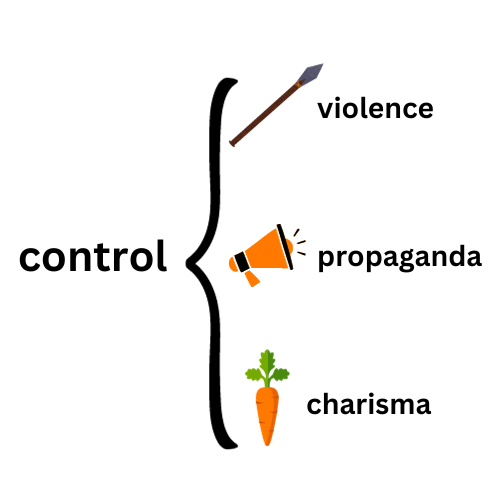
If you think about the vast majority of U.S. control, most of it, at least on the home front, comes in the form of propaganda and charisma. We have a celebrity culture and a cable news intelligence, both of which select and filter the information we receive into a very narrow band, and package it in a consumeristic format to serve it up as desired, based on whichever party or issue you support. This propaganda is power because it can elicit actions without the risk of injury to the propagandist. It helps the controller to save face which violent action would expose, and it helps the propagandist to control from relative safety.

The other major thing you should know about propaganda is that, as Jacques Ellul points out so well, propaganda is polarizing. Propaganda functions not only through the filtering and framing of information, but also through the polarization of groups. Propagandists are not only informers, they’re also saviors. See, a propagandist will always identify an enemy for you that you need to hate, then offer you the solution to save you from your enemy. Whether that enemy is a group of people or certain feelings or states, propagandists will identify an enemy for you which only the propagandist can slay. And once you’ve gone over to the propagandist’s side, they will continue to move you more and more towards their pole through selective information.
With those two major functions of propaganda in view, I started my season by taking a look at the smallest form of propaganda. I started small because I believe that by beginning with the basics it becomes much easier to see propaganda when it’s implemented on a large scale. Our first section took a look at domestic abusers. Depending on how you define propaganda, it may be strange to think of abusers as being propagandists, because propaganda is generally thought of as occurring in larger networks. Yet I think there’s a strong case to be made for how the manipulation of domestic abusers is very much a form of propaganda. Abusers isolate or polarize their victims. Abusers control the information that those close to the victim receive.The victim sees one face while the victim’s friends and family see another. Abusers also isolate their victims, creating an echo chamber in which only the abuser’s voice and information can be heard. The abuser may be abusive, but he also becomes more and more a savior. He can free the victim from her isolation. He best knows how to take care of her. He provides for her. And the list goes on.
Of course, all of this is couched as benevolence on the part of the abuser. Everything he does is for the victim’s good, or so he says. And when a victim seeks to leave an abuser – when she dares to have the audacity to scorn the abuser’s propaganda, it is the most dangerous time for her. It’s when the abuser shows his true colors by unmasking the violence his manipulative propaganda had been masking and keeping at bay. Domestic abusers are master propagandists because overt violence tends to be so risky, and they must become masters of control in order to continue doing what they do.
Domestic abusers are master propagandists because overt violence tends to be so risky, and they must become masters of control in order to continue doing what they do.
Derek Kreider
After looking at domestic abusers, we also took a look at racist propaganda. Many of the same concepts were mimicked here. Why did slave masters prevent the enslaved from learning to read or why were special slave Bibles printed that cut out large portions of the Bible? Because the slavers wanted to isolate the victims. Paternalism as pseudo-benevolence is also a common trait we see among racists – this idea that the abuse and the abuser were actually good for victims. And, of course, when the victim begins to walk away – when the victim begins to legislate against racism, begins to elect presidents who are black, or begins to tear down monuments erected to racists and racism – the abusers lose their minds because they recognize they’re losing control.
The rest of the season goes down the list of institutions which propagandize: the corporate world, the media, the medical community, and the government. Each of these institutions propagandizes in similar ways, but each has its own unique spin on propaganda. The media, for instance, often propagandizes through choosing what to silence, whereas corporate propaganda often focuses on the shaping of desires. There is definitely nuance, but there is always a common thread.
… my Evangelical community has so often claimed to be fighting for Jesus, when in reality, it’s been wielding Jesus and the Bible in order to control
Derek Kreider
Uncovering propaganda has been extremely insightful for me. It has helped me understand how my Evangelical community has so often claimed to be fighting for Jesus, when in reality, it’s been wielding Jesus and the Bible in order to control. Why have conservative Evangelicals started losing their minds over the last few decades – and especially in the last five years? Because they recognize that they’re losing power. The demographics of the U.S. are changing and there are more people deconstructing than ever before. With an inevitable loss of political power in view, conservative Evangelicals have been willing to sacrifice their moral ethic to elect someone like President Trump, and to openly talk about violence as those like Huckabee and Metaxas have done, or to even go so far as to support insurrection. Abusers don’t like losing control, and studying propaganda has helped me to see that my community has rarely been about embodying the ethic of Jesus, and more about ruling as the Gentiles do – through domineering power. We have so often been the abusers, and now our victims – minorities, the LGBTQ+ community, women, youth – have had enough. They’re speaking up and they’re not allowing the Christian Right to propagandize them any more and keep them silent. So our propaganda is turning to threats of violence as well as actual violence. But we don’t see it. And that is perhaps one of the biggest powers of the propagandist – not only to propagandize their victims, but to propagandize themselves to not see who they truly are.
 The Kingdom Outpost
Leave a comment